
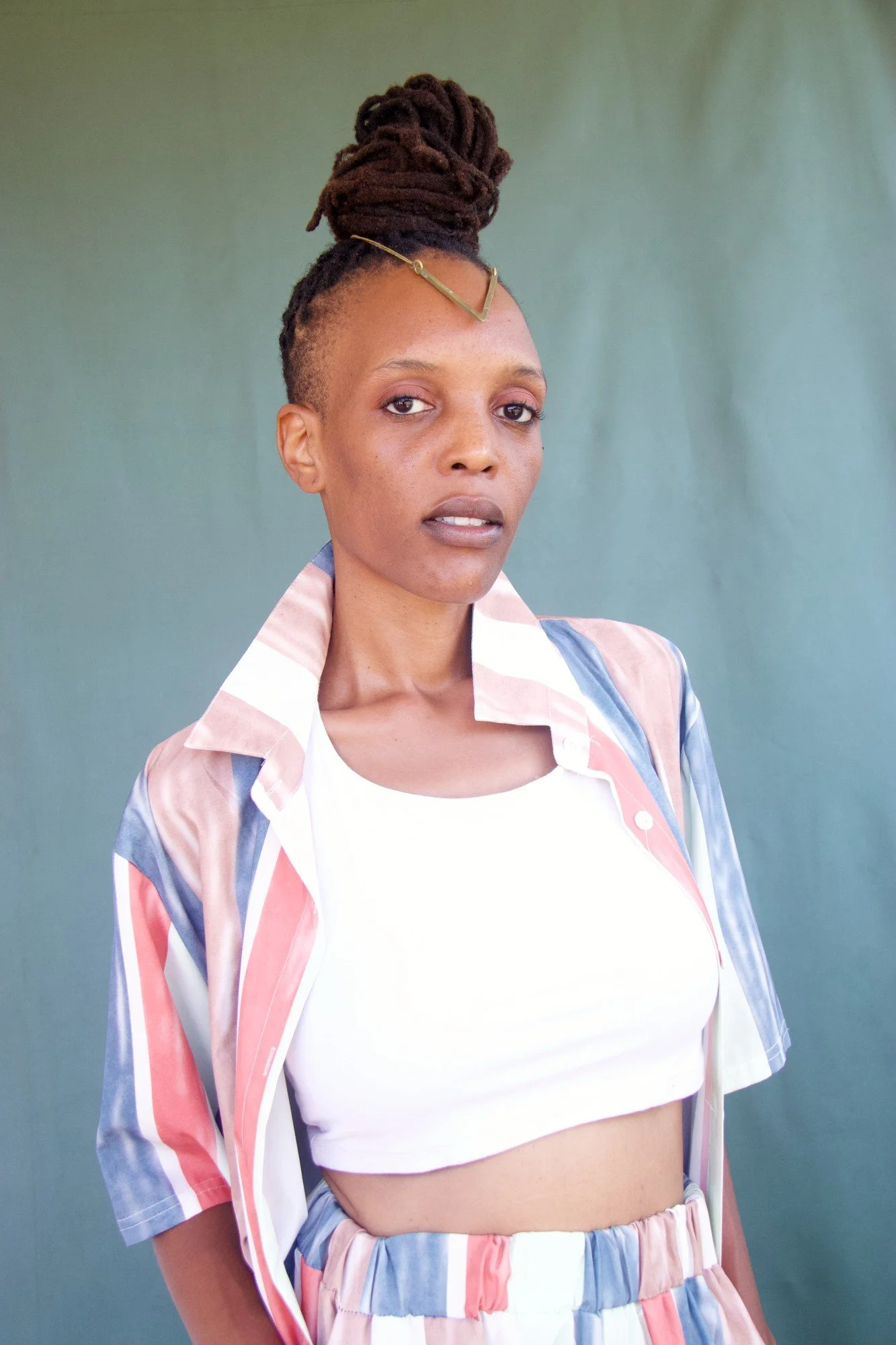

betina quest creates music that pierces with emotional clarity and upends convention. Records are interwoven with tendrils of neo-soul, electronic, lo-fi hip-hop and spell-binding spoken word, while informing a sound that is entirely distinct from any of those influences. For the Burundian artist now based in Ghana, her life in motion informs every note. It’s with a strong reflective voice that she constructs art that resonates and lingers. Each piece adding to a growing sense of homecoming. Not to a place, but to self. “Music is a place of healing for me, and I love to extend that to others,” she says.
Born and raised in Germany, music was always a means to belonging and connection. First with her siblings, as a member of a cover band coached by her brother and then in an R&B girl group with her sister. Her subsequent studies at the PopAkademie (University of Popular Music And Music Business) pushed her toward finding her voice – a transition that began in Chicago where she did an exchange semester. “I used to be alone, the only Black kid out of hundreds of students,” bq explains. “They put me in a box that made sense [to them]. It was the only thing I knew. So Chicago was a very important learning lesson for me to find my own sound and more authentic storytelling.” It was around this time that her EP ‘questape Vol. 1: Street Style’ began to take shape. A striking debut – guided by her street set-up during a European busking tour – the 2013 release was recorded live, in one-take, with no post edits. “Those were all the ingredients I needed to go for it. I decided I no longer wanted to perform. Instead, I wanted to be and create like nobody's watching or listening. And it doesn't mean that it's just for me. It means that I am with me, and you're invited in.”
With the tone set clearly, bq continued the exploration inward and outward. A touring stint with Cirque du Soleil was followed by international one-woman shows where she created music in real-time. In 2017, ‘questape Vol. 2: Spoken Words’ was released. On the six-track EP, the singer-producer and poet tenderly navigates love, loss and identity with no rulebook. It is indeed exactly this suspension of expectation which eventually led her to Ghana, where she now lives. “[The move] affected everything. It influenced how I write, my perspective and even my accent changed. I'm more sensitive to some things and others don't matter to me as much anymore.”
Writing from and for her community, the album ‘room in a room’ arrived in 2020. That project marked a pivotal expansion in her approach. A life shaped by movement crystallised into a virtual installation: her production sensibilities melding with original photography, alongside lyrics translated into five languages. The lead single "Ikangure" is a synth-assisted manifesto for Black excellence and liberation. To really find power and comfort in vulnerability is a soul-baring journey, and betina quest’s music does just that. “I do believe that music was sort of the gateway for me, and then I was able to translate that to all the aspects of my life, and that's what I hope to do for others.”
Where her earlier work was like clearing soil and sowing seeds, betina quest’s next chapter is firmly rooted—no longer searching for truth, she sings from within it. Her upcoming EP, ‘the book you never wrote’ marks a clear turning point in both sound and self. “The idea came to me when my father passed away. He was very adamant about saving his story, always talking about writing a book about his life.” What emerged from this homage was a story of migration that reflects its force – a commitment to community, a search for liberation both personal and collective.
“I’m honouring the story of my father and all of his peers,” she explains. “Everyone who dared so bravely to come to this new world. It's a thank you to them, and then it's also an invitation to us, their children, to find closure and healing within us. We can break the cycle, we can move forward with more understanding. At the very least, it can be a reminder that we’re not alone, we are loved.”
